





Too long to read? Here's the quick summary:
- A marathon relies on 3 levers: glycogen reserves (before), regular intake (during), recovery (after).
- The most effective strategy is simple and tested: break it down, drink early, eat early, don't improvise on race day.
- The longer your marathon lasts, the more "central" nutrition becomes: energy, sodium, digestion, mental clarity.
Marathon Nutrition: The Complete CAMPUS Guide (Preparation + Race Day + Recovery)
A marathon is 42.195 km. Beyond the distance, it's a long effort where your body eventually runs out of "fast" fuel if you don't anticipate it.
The mechanics are simple: you run on a mix of carbohydrates (glycogen + intake) and fats. The problem is that your glycogen reserves are limited. And when they run out (often around the famous "wall"), everything becomes harder: pace, coordination, mental clarity, morale.
The good news: nutrition can be planned. And when it's well-tuned, it doesn't magically "boost" you: it mainly allows you to maintain your level for longer. That's exactly what you want in a marathon.
1) The #1 principle: your marathon starts before the race
In a marathon, classic mistakes don't come from a "bad gel" or a missed aid station. They usually come from:
- sub-optimal reserves (approximate pre-race week),
- intake that's too late (you wait until you're hungry or struggling),
- overly complex strategy (too many formats, too many new things),
- untrained digestion (the gut doesn't like surprises).
CAMPUS Goal: build a simple, repeatable plan adapted to your effort duration.
The 5 field rules
- Start early (drink and eat before things go wrong).
- Break it down (small intakes every 15–25 minutes rather than one big one).
- Test during training (long runs = laboratory).
- Manage sodium (especially if hot / heavy sweating / cramps).
- Keep it simple (race day: no new things).
2) During preparation: eating to handle the load
Marathon preparation involves weeks of consecutive efforts: endurance, specific pace, intervals, long runs, sometimes strength training. If you under-eat, you don't "lose weight" properly: you exhaust yourself.
Carbohydrates: the fuel for marathon training
Useful benchmarks (to adjust according to your weekly volume):
| Training Load | Carbohydrate Benchmark | Example for 70 kg |
|---|---|---|
| Moderate prep | 5–7 g/kg/day | 350–490 g/day |
| Sustained prep | 6–8 g/kg/day | 420–560 g/day |
| Heavy blocks / heavy weeks | 7–10 g/kg/day | 490–700 g/day |
Translation: the more you increase duration and frequency, the more you need to support your intake. You can eat "clean" and be in deficit every day. But you cannot do "marathon prep" and be in a permanent deficit without paying the price.
Proteins: repair, preserve, recover

In a marathon, recovery is a sport in itself. Simple benchmark:
- 1.4 to 1.8 g/kg/day depending on load and intensity,
- divided into 3 to 4 intakes throughout the day.
Remember to vary plant and animal sources.
And when you finish a session and don't have your meal handy, a structured snack is often what makes the difference between "I'm recovering" and "I'm accumulating." The RECOVERY protein bars are specifically designed for this (simple format, easy to carry, useful right after exercise).
Hydration: daily baseline + sport adjustment
Simple daily benchmark: approximately 30–35 ml/kg/day (excluding sport), then adjust according to your sessions.
If you want to objectify it once and stop guessing: weigh yourself before/after a long run. Each kilo lost ≈ 1 liter.
3) The week before: stabilize, simplify, fill up
The last week is not the time to "revolutionize" your diet. It's the time to make things simpler and more digestible.
D-7 to D-4: no big changes
- regular meals,
- starches present at each meal,
- stable hydration
- no experimentation (no "miracle superfood").
D-3 to D-1: optimized carbohydrate loading
For a marathon, temporarily increasing carbohydrates 36 to 72 hours before the race helps saturate glycogen stores. This is a classic, useful, and very concrete protocol.
A commonly used benchmark: 8 to 12 g of carbohydrates/kg/day over 2–3 days (to be adjusted to your tolerance). That's a lot, so the strategy is not to "eat heavier." The strategy is to eat more carbohydrate-rich and more digestible foods.
The 4 carbohydrate loading rules to avoid trouble
- Reduce fiber (especially if you have a sensitive gut): less whole grain, fewer raw vegetables.
- Reduce fats: they slow down gastric emptying.
- Break it down: 3 meals + 2 snacks rather than 2 huge plates.
- Drink regularly: filling glycogen = also storing water.
| Goal | What you prioritize | What you limit |
|---|---|---|
| Fill glycogen | rice, pasta, semolina, white bread, potatoes, compotes | large excess of fiber and fats |
| Stable digestion | cooked foods, fractionated portions | raw vegetables, "test dishes" |
| OK hydration | drink often, small sips | over-drinking all at once |
4) Race day: breakfast, waiting, start
Breakfast: simple, familiar, digestible
Goal: a final refill without digestive discomfort.
- Timing: ideally ~3 hours before the start (adjust to your preference).
- Composition: easy carbohydrates + moderate fiber + limited fats.
- Rule: nothing new on race day.
Typical examples (to adapt and test): semolina/rice pudding (or plant-based alternative), bread + honey/jam, compote, banana. If you tolerate it: a little light protein, but without heavying yourself down.
Waiting before the start: avoid "water in the stomach"

Between breakfast and the start, a common mistake is to drink too much at once, or to stop drinking altogether.
- small, regular sips,
- if you're used to it: an energy drink can serve as a waiting drink in small quantities.
For a simple option in training as well as during the race: COOKNRUN energy drinks (hydration + stable energy, without forcing you to use multiple products).
5) During the marathon: the aid station plan that keeps you going
During a marathon, you don't "reconstitute" your reserves: you smooth out blood sugar and delay glycogen depletion. For that, you need to be regular.
How many carbohydrates per hour?
Useful benchmarks (to adapt to your level and tolerance):
- 30–60 g/h: solid base for many runners.
- 60–90 g/h: rather for those who have trained their digestion (and know they can handle it).
The key point: it's not "one intake every hour." It's a continuous trickle: every 15–25 minutes, you take a little.
Hydration during: enough, without excess
Common benchmark: 250 to 500 ml/h (or more if very hot / heavy sweating), in small sips. The goal is not to "drink the maximum," it's to maintain a stable level.
Sodium: the forgotten element that costs dearly

The hotter it is, the more you sweat, the more important sodium becomes (for fluid retention and balance). There isn't a universal dose, but there is a principle: if you're a heavy sweater, if you've had cramps before, or if the weather is hot, you need to plan for it.
And to avoid "all sweet" saturation (a classic after 2–3 hours), a simple salty option can help. The Ultra Crackers are a practical format when you want to avoid the "chips at the aid station" solution and keep something cleaner and more controllable.
Bars: yes, but at the right dose (and at the right time)

Chewable formats can work very well... if you've tested them and manage the timing. Many runners prefer to chew at the beginning/middle of the race, then simplify when digestive fatigue sets in.
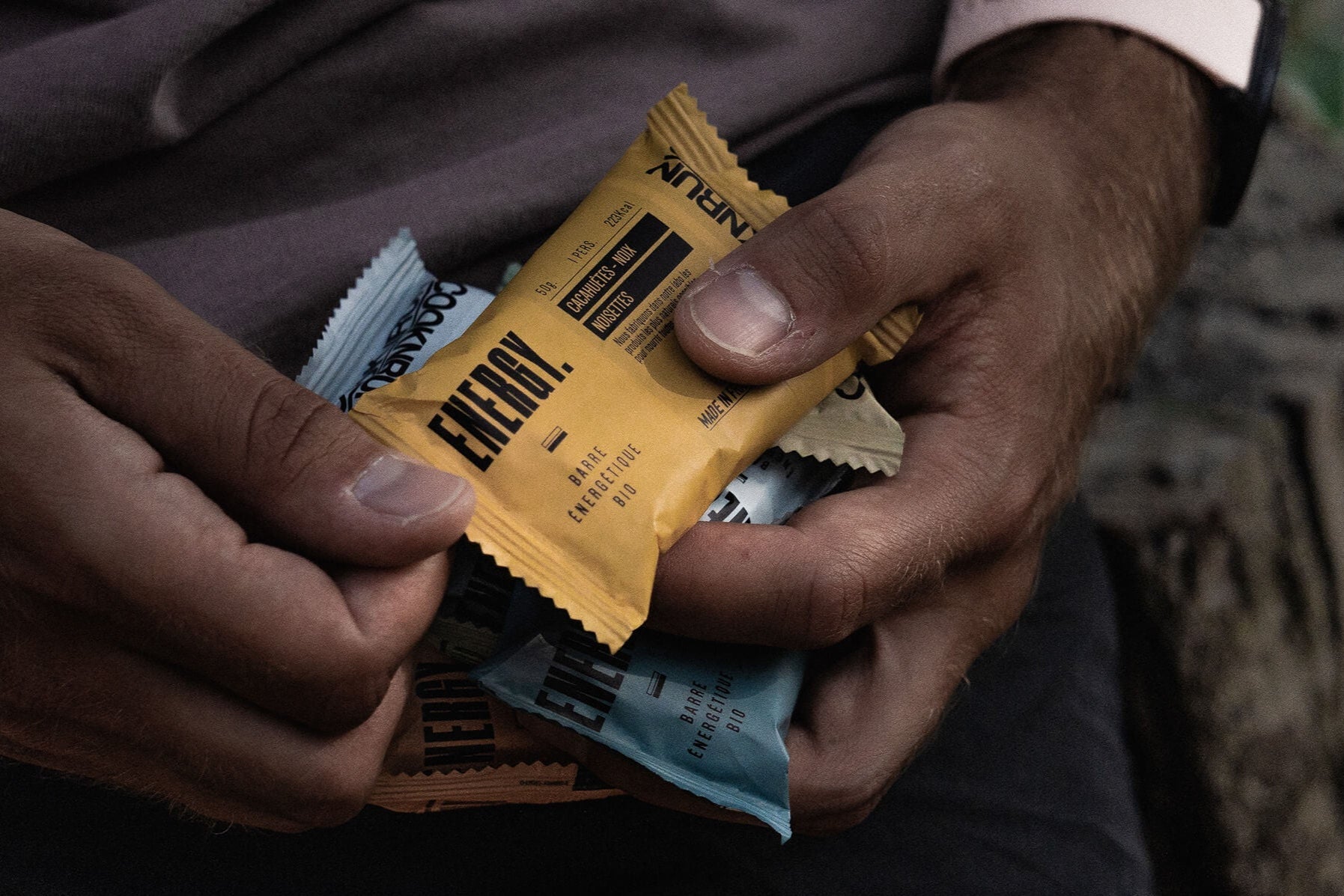
To structure your long runs (and train your digestive system), COOKNRUN energy bars are a simple format: easy to break up, easy to carry, and useful for learning regularity.
Table: example of frequency (to adapt)
| Frequency | Goal | What it changes |
|---|---|---|
| Every 15–20 min | Very regular intake | Fewer peaks/troughs, better tolerance if small doses |
| Every 25–30 min | "Comfort" regularity | Often easier to maintain mentally |
| Once / hour | To avoid | Too many lows, large intakes at once, digestive risk |
6) Concrete plans based on goal (3h / 4h / 5h)
These plans are frameworks. To be personalized according to: weather, aid stations, digestive tolerance, and what you have already tested.
Marathon ~3h ("regular and light" strategy)
- start: hydration in small sips,
- carbohydrate target: rather 60 g/h if tolerated,
- intake: frequent small intakes + energy drink if needed.
Marathon ~4h ("anti-wall" strategy)
- carbohydrate target: 45–75 g/h depending on tolerance,
- strict fractionation every 20–25 min,
- plan for a "salty" option if sweet saturation occurs (useful after 2h30–3h).
Marathon ~5h and + ("energy survival + digestion" strategy)
- carbohydrate target: 30–60 g/h but most importantly sustained over time,
- drink regularly even if not thirsty,
- introduce varied textures (chew a little at the beginning, then simplify).
To transform these frameworks into a clear plan (with times/intakes), the simplest tool is SHERPA: a 100% personalized aid station planner, based on your profile and your effort. The goal: remove doubt and avoid deciding "on feeling" at km 30.

7) Digestion: how to avoid problems (and train for them)
During exertion, blood goes primarily to the muscles. The gut works less efficiently. So digestion becomes a skill to train, not something "random."
Common causes of digestive problems
- intakes too concentrated at once (or too spread out),
- mixtures too rich in fats or fiber during exercise,
- overconsumption of "all sweet" without variation,
- drinking too much at once at aid stations,
- untested products.
Solutions that often work
- Fractionate: micro-intakes, micro-sips.
- Stay consistent: same protocol on long runs.
- Vary when necessary: if sweet saturation, plan for a simple salty option.
- Train the gut: if you're aiming for 60–90 g/h, you need to gradually habituate it.
8) After the marathon: recover without complicating your life
Immediately after, you may not be hungry. That's normal. But your body has a clear need: rehydrate, recharge, repair.
Within 30–60 minutes
- drink in small sips,
- take in carbohydrates + protein if possible (don't force it if your stomach is closed),
- prioritize what goes down easily: sometimes semi-liquid is easier.
A simple option when you want to kickstart recovery without overthinking: a snack with RECOVERY protein bars (link already given above, only once per page).
Within 2 to 4 hours
A real complete meal: carbohydrates + protein + vegetables (preferably cooked if digestion is sensitive) + good fats. And most importantly: drink regularly.
9) The CAMPUS plan in 1 table
| Phase | Objective | The game-changing reflex |
|---|---|---|
| Prep (weeks) | Handle the load | Sufficient carbs + distributed protein + stable hydration |
| D-3 to D-1 | Fill glycogen | Digestible carb load, reduced fiber/fats, fractionated meals |
| Race Day (before) | Start "full" and light | Simple, familiar breakfast, 3h before |
| During | Avoid the wall | Fractionate (15–25 min), drink early, manage sodium |
| After | Recover quickly | Drink + carbs/protein as soon as possible, then full meal |
Last rule: if you want to perform in a marathon, you need to make your nutrition as "trained" as your legs. Long runs are not just for running long. They are for repeating your plan until it becomes automatic.
Bonus
Our ULTRA nutrition pack, dedicated to marathons and long races. The essentials, to adapt according to your needs.


Bonjour, toujours très instructif mais je ne sais pas si vous avez essayé de manger une barre même en petite portion quand vous êtes sous les 3h c’est compliqué. Pourquoi ne pas réfléchir à des gels aussi éthique que vos barres ou boisson. Comme des sticks de sirop d’érable. Belle journée