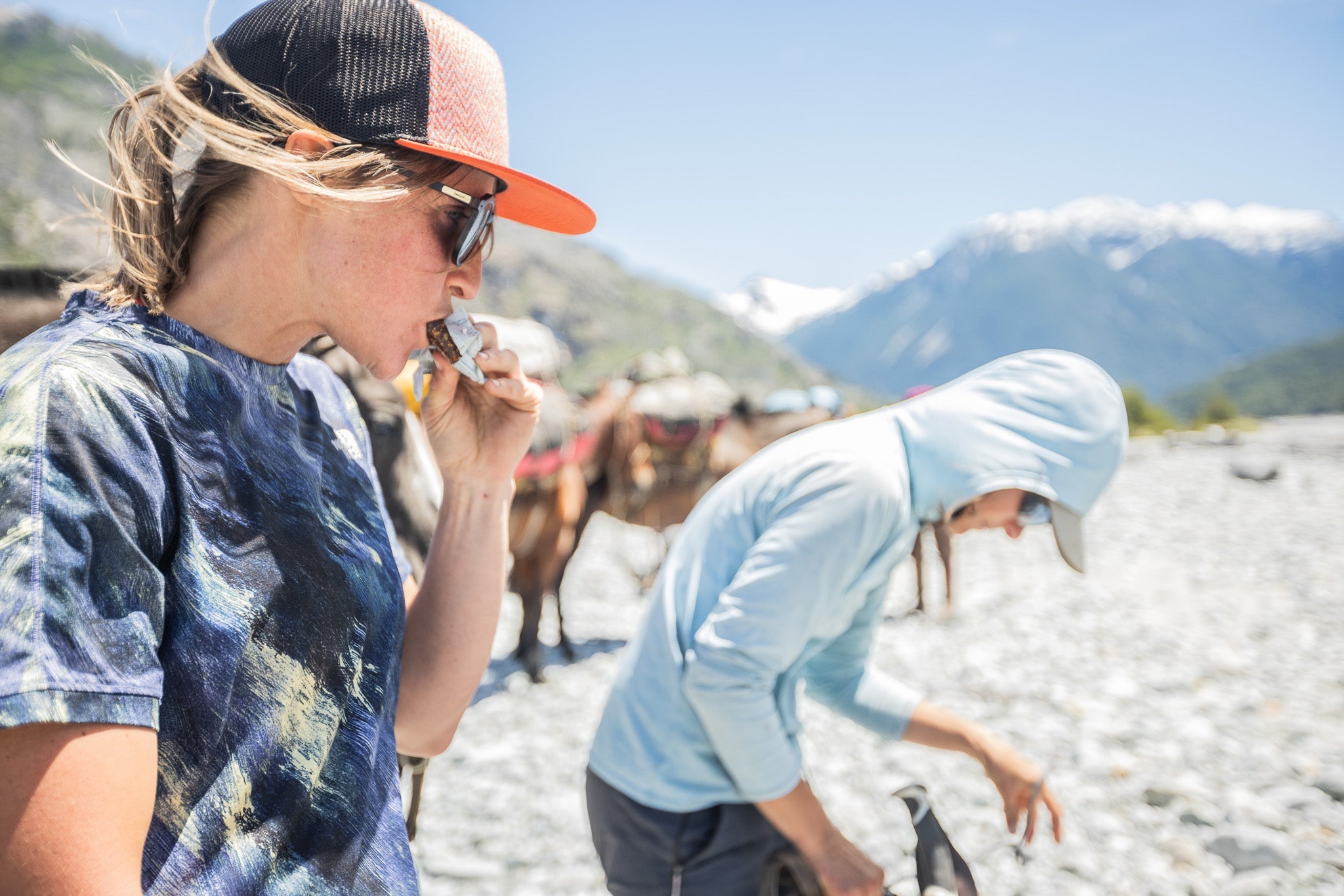
To delve into the world of the Tor des Géants is to embark on an extraordinary adventure. This legendary race in the Aosta Valley attracts ultra-trail enthusiasts from all over the world every year. Just a few hours before the start of the Tot Dret (130 km and over 12,000 m of elevation gain), we met Clément, an experienced trail runner based in Haute-Savoie and a loyal user of COOKNRUN products. He shared with us his preparation, his nutritional choices, his routines, and also his mindset as he faces this exceptional challenge.
Hi! To start, can you introduce yourself in a few words: who you are and what brought you to ultra-trail running?
Hi, I'm Clément, I'm 38 years old, and a father of a 10 and a half month old boy. Based in Haute-Savoie, I've been trail running for 13 years, and ultra running for… 11 years (yes, yes, the "long-distance" running bug bit me quickly).
What led me to this sport was undoubtedly working for four years for the equipment supplier Raidlight, based in the Chartreuse mountains. Unlimited playground, easy access to my first race bibs and equipment, fellow trail runners: in short, the adventure began in 2011! And it continues to this day.
The TOR des Géants is a legendary race. What does it mean to you to be at the starting line?
Indeed, it's a myth. Certainly, I've had the chance to participate in many UTMB races: UTMB, PTL, CCC, TDS.
But the TOR , this event in the Aosta Valley at the beginning of September, had something special, appealing, intriguing, and mythical about it because of the extreme length and difficulty of its flagship races. This year, I decided to take the plunge and discover the event from a smaller perspective with the more "reasonable" 130km format of the TOR Dret . Obviously, with just two days to go, the excitement is at its peak, as I only know the TOR through social media. I can't wait to experience it in person!
Sports routine & preparation

©Nicola_Biagetti
What does a typical week of training look like in your life?
So I'm far from being a role model, since I very rarely follow strict and precise training plans. Generally, I listen to my body a lot, while obviously applying a few basic principles and sessions: base endurance , interval training (less often for me), and alternating long runs and hikes . In short, I try, as much as possible, to spend time in the mountains , but I wouldn't be able to describe a typical training week to you.
Do you have a particular routine or ritual before a big race?
Not really, no. But the common thread is the concentration required before each race: packing your bag, making sure you have all the mandatory equipment, traveling to the start line, eating your pre-race meal, collecting your race number, and planning your race schedule. In the end, the mental load before the race is much greater than the race itself.
How did you specifically prepare for this 130km stage?
The main stages of this preparation were:
- A season on the " road " at the very beginning of the season, to gain speed, with the 10 km of Annecy in April.
- A few short trail runs in May/June ( Tour du Môle, Trail du Salève , etc.) to start working on elevation gain and technical terrain.
- A first "long" trail run of 76 km and 6100 m of elevation gain in early July to get back into the swing of things.
- A summer spent alternating between trail runs, strength and conditioning, and hikes ... with my 11 kg son on my back. Good weight training!!
Which part of the journey do you dread the most… and which one are you looking forward to?
I haven't really thought about the route in detail. But with 48 hours to go before the start, I can say that I'm dreading the very cold nights that are forecast . Some runners currently on the 450km course have encountered snow on the sections above 3,000m altitude.
What I'm most looking forward to is reaching the Col de Malatra . It's a legendary, very alpine pass, the last one to cross before plunging down the long descent to Courmayeur. If we make it that far, hopefully in the early morning on Thursday the 18th, there's a good chance we'll finish.
Nutrition & race strategy

In such a long race, nutrition is key. How do you organize it?
Indeed, proper nutrition is crucial during such a long effort.
My routine is to eat
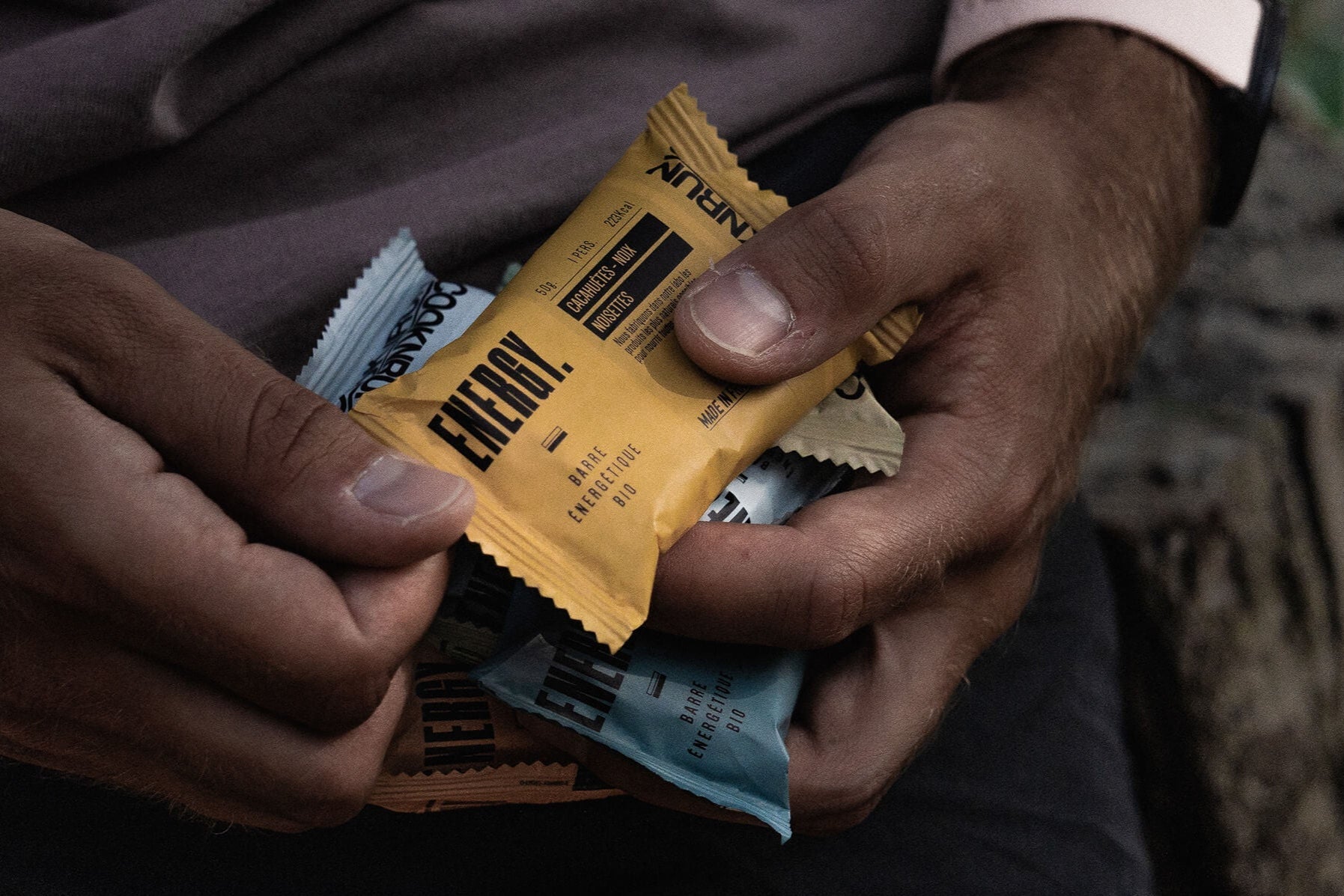
two COOKNRUN Energy bars and one Pom'Potes every two hours, and of course, to stop at all the
aid stations , favoring
savory foods like
soup ,
pasta , or
ham . Ultimately, you lose a lot of
salt during these long efforts. Salty foods are therefore preferred, especially since sugar saturation sets in quickly.
On the Tor, there are aid stations every 7 to 10 km. So we can say that we are well helped by the race at this level, far from the model of semi-autonomous races, like the PTL.
You are used to using our COOKNRUN bars: when do you consume them, and why?
Indeed, I am a big fan of
organic energy bars , even during
training . In competition, as mentioned earlier, my routine is about one bar per hour, uphill, while remaining attentive
to my cravings and feelings of hunger at the time .
I consume them because I feel that, unlike some other products on the market,
theglycemic spike is low and therefore controlled. This allows me to stay in a zone where I won't experience an energy crash
(no pun intended) to manage the rest of my day. In short, I feel they contain many
natural ingredients, no added sugars, and that consuming them regularly works quite well for me!
How do you manage hydration and digestion during an effort lasting several tens of hours?
My few rituals:
- Systematically and regularly test all your products before a competition.
- Drink small sips regularly , alternating between water in one flask and BCAA powder food supplement in the other.
- Never eat "heavy" meals as this puts too much strain on the digestive system . And your blood is already busy making your legs turn.
- Opt for soup at aid stations. It warms you up, hydrates you, raises your salt levels , and is easily digested. In my opinion, it's a key food in ultra-trail running.
Do you have a little nutritional tip that makes a difference for you?
MMMhhhh not really. But something tells me I might find my solution in the COOKNRUN range, especially the
Ultra Crackers ❤️
Feelings, emotions & mind

©Oliver Gough
In the middle of a race, when you find yourself alone in the night, what do you think about?
One important point I haven't mentioned. I won't be running alone . I'll be accompanied by a friend, with whom I've already shared some great adventures in the mountains, whether skiing or ultra-trail running.
So this Tor130 will be under the sign of sharing and mutual aid , precisely to counter this solitude, not always easy to manage, alone in the night.
But with the hindsight of past experiences, these moments alone in the mountains resemble meditation sessions for me: you are focused on yourself, thinking about the next summit, the next pass, the next refreshment stop.
What keeps you going when fatigue or doubt sets in?
For my part, I must admit that in those moments, my strength lies in others . I seek support in the eyes of spectators, messages from friends, the help of the person managing my assistance, and the support of my running partner. I have always said and loved this phrase: "Ultra-trail running is a team sport."
I know from experience that in ultra-running, it's a bit of a rollercoaster of sensations and emotions. In a bad moment of fatigue and doubt, I now know that a better moment will follow .
Have you ever experienced a very difficult moment in a race that left a mark on you, and how did you overcome it?
The most difficult moment was undoubtedly during the PTL 2022, on the evening of the second day. We were a team of three runners. By that point, we had spent several hours "gardening" (the course is unmarked, we had to navigate ourselves) , the extremely technical off-trail terrain had slowed our progress considerably, I had injured my elbow quite seriously in a fall, and on top of everything, we were exhausted having barely completed a third of the race. In short, the decision was made in my mind: we were giving up ; the challenge was too daunting, too overwhelming.
But one of us still harbors a spark of desire, pushing us to go a little further… at the next aid station. We finally regain our strength and ultimately go much further… The unfortunate end of our withdrawal three days later still gave us the feeling of having fully experienced this race and honored this extraordinary event.
In summary, it was once again the strength of the collective that allowed us to overcome this moment!
Are there also magical moments you're looking forward to: sunrise, crossing a mountain pass, atmosphere at the aid station?
The start is already a powerful moment. The finish is too, as it symbolizes the accomplishment and success of the challenge met. As for the rest, I can hardly imagine it: the race that awaits us will create its own magical moments. That's the very definition of adventure. Okay, one little thing I did dream about: crossing the Malatra pass at sunrise, leaving only that long descent to the finish line ahead.
Motivation & projection

What motivates you to take on such an extreme challenge?
The beauty of the landscapes, the adrenaline, the atmosphere, and the emotions that finishing such a race brings. I often say that when you buy a race bib (sometimes expensive for the most prestigious races), you're buying a souvenir!
Do you run mainly to push your own limits, or also to inspire others?
I do this 100% for myself. I don't have the ambition or the pretension to inspire others . However, if it happens spontaneously, I'd be happy to share my tips and tricks as an amateur runner with anyone wanting to try ultramarathons!
When you cross the finish line, how do you think you'll feel?
So, let's just say "if" I cross the finish line (which is never a given at the start of a race like this), I think I'll feel fatigue first, then pride. Ultimately, what I particularly love about this sport is that it allows you to appreciate life's simplest things on a higher level: the post-race beer first, then the meal, the taste of coffee, the warmth of a shower, and the comfort of a bed. These everyday things take on a whole new meaning after 40 hours spent in the mountains...
If you had to give one piece of advice to someone who dreams of one day running the TOR des Géants, what would it be?
So I think I'll be much better able to answer that question in a few days. For now, I'm just a Tor rookie, just ready to take the start!
One last word to your loved ones, supporters, or those who follow your race?
Let's Rock the Tor!