







Quick Summary:
- Success in a half-marathon is largely determined by preparation: sufficient energy, solid recovery, and stable digestion.
- Nutrition objective: carbohydrates (fuel), protein (repair), hydration (regulation), with timing adapted to each session.
- On race day, the best strategy is the one you've already tested: simple, consistent, and personalized.
A half-marathon is 21.1 km. For most runners, that's between 1h20 and 2h30 of effort. For this distance, nutrition is not the same as for a marathon, but it's far from being a minor detail.
The key point: you don't "succeed" in your half-marathon with a plate of pasta the night before and a gel at km 15. You succeed in your half-marathon with consistent preparation: weeks where you manage to string together sessions, recover, and progress without burning out.
In this CAMPUS article, we're going to build a complete strategy: what to eat during prep, how to time your intake around sessions, how to hydrate intelligently, and what to do on race day depending on your profile. The goal isn't to make it complicated. The goal is to be reliable.
1) Preparation: the real "fuel" for the half-marathon
Over 8 to 12 weeks, your body endures:
- an increase in volume (mileage + duration),
- qualitative sessions (intervals, half-marathon pace, hills),
- long runs that progressively deplete reserves,
- nervous and muscular load that requires repair.
At this stage, the #1 mistake isn't "eating poorly." It's "not eating enough," or "eating well, but at the wrong time." The result: accumulated fatigue, missed key sessions, and sometimes lingering aches and pains.
The 4 mistakes that sabotage most preparations
- Chronic undernourishment: you reduce your intake too much to "stay light." You primarily lose training quality.
- Underestimated carbohydrates: you want to be "clean," you forget that half-marathon pace consumes glycogen.
- Hasty recovery: you finish a hard session, you wait hours before eating. You rack up the debt.
- Ignored digestion: you try things at random, without progression. On race day, your stomach won't forgive you.
The goal of nutrition prep
In plain language: sustain the load and absorb the weeks.
Good preparation nutrition serves to:
- maintain stable energy daily,
- replenish reserves between sessions,
- repair muscle fibers,
- limit the risk of digestive issues,
- arrive at the start line with a fresh body, not "overtrained."
2) Key figures: carbohydrates, protein, hydration
Carbohydrates: your fuel for progress
Carbohydrates are not just for "during the race." They are primarily for:
- fueling quality sessions,
- replenishing muscle glycogen,
- avoiding chronic fatigue when you chain sessions together.
Useful benchmarks (to adjust based on your weekly load):
| Weekly Volume | Frequency | Carbohydrates (benchmark) | Example for 70 kg |
|---|---|---|---|
| 20–30 km | 3 sessions | 5–6 g/kg/day | 350–420 g/day |
| 35–45 km | 4 sessions | 6–7 g/kg/day | 420–490 g/day |
| 50–60 km | 5 sessions | 7–8 g/kg/day | 490–560 g/day |
You don't need to weigh your rice your whole life. But you do need to understand one principle: the higher your load, the higher your carbohydrate needs. Otherwise, you'll spend your prep "surviving" instead of progressing.
QUALITY: feel free to include whole or semi-whole grains at the beginning of prep. But switch to "traditional white" in the last week to avoid overloading your digestive tract.
Protein: the pillar of recovery

Protein is primarily for repair, maintaining muscle mass, and supporting recovery (including tendons). Useful benchmark:
- 1.4 to 1.8 g/kg/day depending on load and intensity,
- ideally distributed over 3 to 4 intakes.
The classic pitfall: having protein only in the evening. It's better to distribute it throughout the day, especially if you're doing back-to-back sessions.
Remember to alternate sources: animal & plant-based.
SPOILER: the reference protein is egg.
In practice, a simple solution when you finish a session and don't have your meal ready: a structured snack. RECOVERY protein bars are typically made for this: practical, portable, and useful for "starting" recovery.
Hydration: daily baseline + training adjustment
A simple benchmark for everyday life: approximately 30 to 35 ml/kg/day (excluding sports). Then, you add based on:
- session duration,
- heat,
- your perspiration,
- intensity.

A simple indicator: rather clear urine during the day (without aiming for "transparent"). And if you want to objectify it once and for all: weigh yourself before/after a long run. Each kilo lost ≈ 1 liter.
For sessions where you want to stabilize energy and comfort (heat, long runs, specific pace), an energy drink makes sense. At COOKNRUN, we deliberately use the term energy drink (and not "isotonic" as a medicalizing term): COOKNRUN energy drinks.
3) Timing your nutrition around sessions
The most effective strategy isn't to "eat better" in an abstract way. It's to synchronize what you eat with what you do.
| Session Type | Before | During | After |
|---|---|---|---|
| Long run (> 90 min) | Meal 2–3h before, simple | Regular intake if needed | Carbohydrates + protein within the hour |
| Half-marathon pace / intervals | Light snack 30–60 min before | Water (often sufficient) | Quick recovery + meal |
| Base endurance | Optional depending on profile | Water | Balanced meal |
Long run: where you test everything
The long run is the laboratory. This is where you test:
- your intake frequency,
- your textures,
- your digestive tolerance,
- your routines (hydration, snacks, timing).
The most reliable rule: fractionate. Small, regular intakes rather than one large intake all at once.
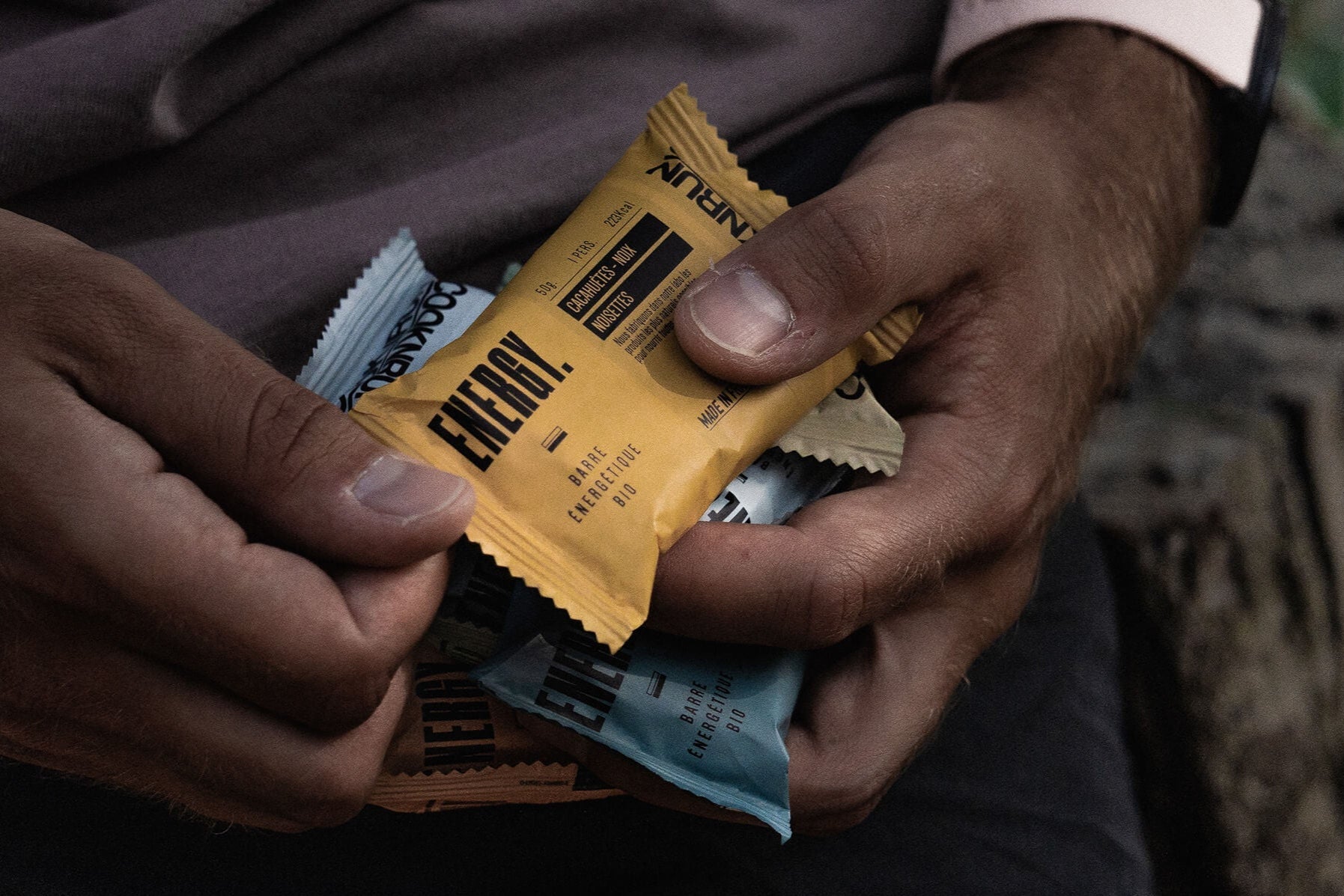
In practice, COOKNRUN energy bars are a simple format to integrate into training to practice this fractionation: you can take one piece, then another, without feeling overwhelmed all at once.
Half-marathon pace and intervals: light before, solid after
During intense sessions, the digestive system isn't happy if you arrive with a heavy meal in your stomach. The idea:
- before: light, digestible, sufficient,
- during: often unnecessary (sessions not long enough),
- after: this is where you gain consistency over 8–12 weeks.
It's not "a magic window" to the minute. It's a simple principle: the longer you wait, the longer you extend your recovery. And the longer you extend, the more debt you accumulate.
Base endurance: useful, but not an excuse to deplete yourself
Running easy is fundamental. It's also a trap if you go "too light" all the time.
Yes, an easy 45–60 min run can sometimes be done without significant intake just before, depending on your profile. But the goal isn't to start "on empty" to prove something to yourself. The goal is to build an endurance base, without burning yourself out over the week.
Rest days: adapt, don't cut off
Rest day = less immediate energy need, but still a need for repair. Adjust:
- a little less carbohydrates if the load decreases,
- stable protein,
- cooked vegetables and tolerated fibers (depending on your gut),
- regular hydration.
4) Race Day: simple, tested, personalized strategy
On race day, you need to be on track. No improvisation. No "new recipe." No novelty "because it's recommended."
The 48–72 hours before: simplify, stabilize, digest
Without going into a marathon-level carbohydrate load, you can optimize:
- simple meals, rich in carbohydrates,
- moderate fiber (avoid excess if you are sensitive),
- regular hydration (without overdrinking),
- zero novelty.
Breakfast (ideally ~3h before)
Goal: available energy + quiet digestion.
- prioritize easily digestible carbohydrates,
- limited fats,
- moderate fiber,
- progressive hydration.
Examples (to adapt and test beforehand): bread + honey, semolina, well-cooked rice, compote, banana, hot drink if you're used to it.
Drinking during the race: regular, without obsession
For a half-marathon, the main risk is not "extreme dehydration," but the combo:
- stress + dry mouth,
- heat + sweating,
- sustained pace + digestive discomfort.
The simple plan: a few sips at aid stations, especially if it's hot. If you know you sweat a lot, an energy drink can stabilize your comfort.
Should you eat during a half-marathon?
It's not systematic. It depends on:
- your duration (the closer you are to 2h, the more it can help),
- your experience,
- your stress (which can disrupt reserves and digestion),
- your digestive tolerance.
Two common approaches:
-
"Minimalist" approach: you start with optimized reserves, you drink at aid stations, and you don't eat (often okay if you run < 1h35–1h45 and are stable).

- "Secured" approach: an intake in the middle of the race (or 1–2 micro-intakes), especially if you're closer to 1h50–2h30 or if you know you tend to hit a wall.
For the "secured" approach, some people also need to break up the all-sweet (satiety). In this case, simple savory can help. Ultra Crackers are a "clean" field alternative when you want to avoid chip-type solutions at aid stations, especially on long training runs.
The key point: personalize without improvising
The best nutrition plan isn't the one that looks "perfect" on paper. It's the one you execute without thinking, because you've already experienced it.
For this, the simplest tool is to transform your fueling into a clear protocol. This is exactly the goal of SHERPA: to build a personalized fueling plan based on your profile, your effort, and your habits, to avoid improvising on the day it counts.

5) Digestion: the underestimated limiting factor (and how to train it)
During exercise, the digestive system is under stress: blood flow is prioritized to the muscles. The result:
- slowed digestion,
- less efficient absorption,
- increased sensitivity (nausea, bloating, side stitch, urgency).
The solution is not to "eat nothing." The solution is to make your digestive system more tolerant.
The 4 digestion rules that almost always work
- Fractionate: micro-intakes every 20–30 minutes (rather than one big hit).
- Keep it simple: known foods, few novelties, no anarchic mixtures.
- Adapt textures: some people tolerate soft textures better than very dry, or vice versa.
- Test in real conditions: long run, race-like pace, similar weather.
The "Plan B" that avoids panic
In training as in racing, always have a Plan B:
- if you can no longer chew, switch to something simpler,
- if sweet flavors become overwhelming, introduce neutral/savory options,
- if you feel yourself heading for a slump, return to regular micro-intakes + hydration.


