






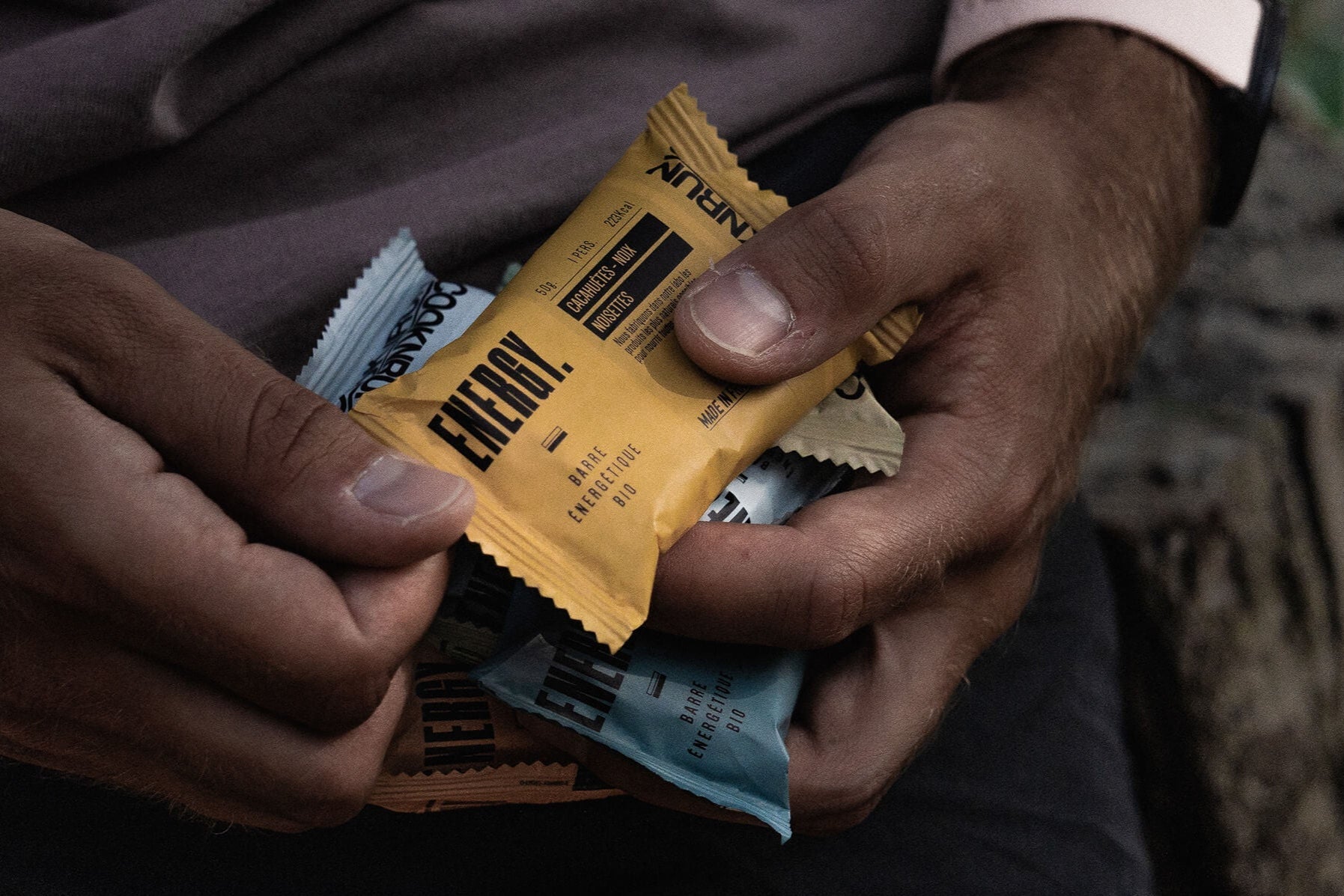

What should you eat before exercising? When should you eat your energy bar? How should you choose your energy bars? Why eat energy bars? We'll try to provide you with some very concrete answers to these questions!
This series of articles is written by Alexis, co-founder of COOKNRUN. Whether as a fitness trainer, athletics coach, or now in nutrition, Alexis has always supported athletes in their projects.
Eat to perform

To understand the importance of good nutrition in the performance process, you need to convince, make sense, and be educational. You need to convey a message, backed by examples and arguments. Convince them that what I eat has an impact on my performance level.
The basics: Building your plate

The role of nutrition in sports practice is to provide satisfactory responses to nutritional needs, both quantitatively and qualitatively. Ensuring macronutrient intake while minimizing acidification and ensuring maximum intake of micronutrients of high biological value. We propose two simple, concrete principles that inform our daily practice.
To progress is to adapt!

Regardless of their training load, the more an athlete practices, the more their body adapts. The coach's job is to surprise the athlete's body, to challenge it. This is the art of training: exposing the athlete to new situations to push them to adapt.
The basics: nutrients, carbohydrates

There are two main families of nutrients: macronutrients, the only nutritional elements that provide energy, and micronutrients, which are the "others" and do not provide any energy.
The basics: the Glycemic Index, carbohydrate needs.

Every athlete has heard of slow-release sugars and fast-release sugars, and the time of day when to eat one and avoid the other. The idea that carbohydrate energy will be delivered to us at a greater or lesser speed is true. The notion of "slow-release sugars" has been overshadowed by an objective metric: the Glycemic Index (GI).
The basics: lipids, “fat”.

First, we need to dispel a persistent misconception: lipids = fat = body fat. Dietary fats don't directly convert to body fat. What is body fat, after all? Energy.


The Basics: Micronutrients

Eating is, first and foremost, a response to a need. The body demands, through the sensation of hunger, nutrients. Meeting these needs means responding quantitatively and qualitatively.

